Somewhere between the first fallen leaf and the first frost, a coat pocket gets filled with glossy brown seeds and a hopeful question follows it home: can these be roasted? Usually they can't. Those are conkers, the seeds of the horse chestnut, and they are the most common case of mistaken identity in autumn foraging.
The good news is that the two trees are easy to tell apart once you know what you're looking at. You don't need a hand lens or a field guide. You need the leaves, the husk, and about thirty seconds.
The Short Answer
If you remember nothing else, remember this: a horse chestnut gives you one shiny round conker in a husk with a few fat spikes. A sweet chestnut gives you two or three flat-sided nuts in a husk that bristles like a sea urchin.
- Horse chestnut (Aesculus hippocastanum): palmate leaves with five to seven leaflets, large sticky buds, upright white flower candles in May, one round mahogany seed per husk.
- Sweet chestnut (Castanea sativa): long, simple, saw-toothed leaves, small pointed buds, creamy catkins in midsummer, two or three flattened nuts per husk.
Horse chestnut seeds are not food. They contain compounds that cause stomach upset in people, and they belong on a string or in a bowl on the windowsill.
Leaves: The Fastest Test
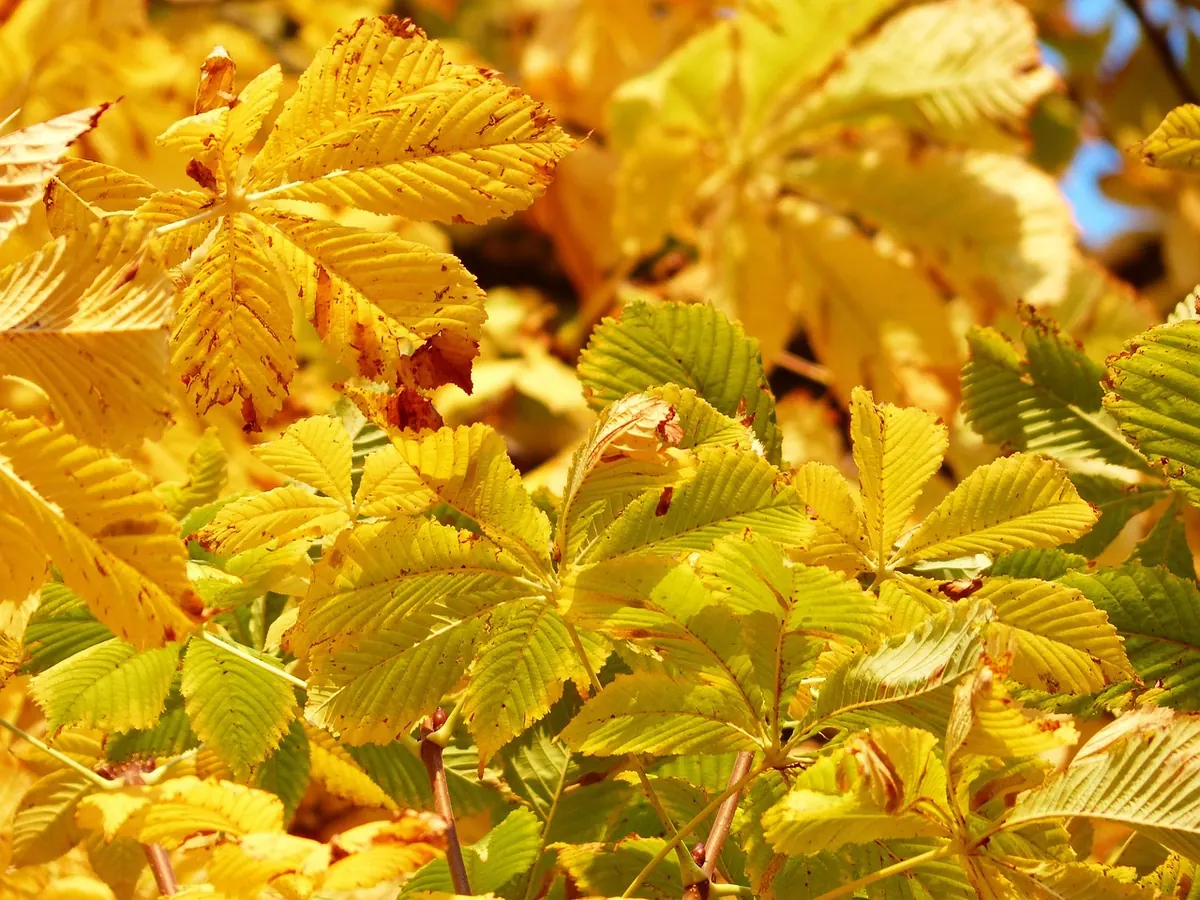
Look up. If the leaf is built like an open hand — five, six or seven leaflets radiating from a single point at the end of the stalk — you're under a horse chestnut. Each leaflet is broad, widest above the middle, with a wedge-shaped base and a finely toothed edge. A whole leaf can be as wide as a dinner plate.
Sweet chestnut leaves are nothing like that. Each one is a single long blade, roughly 15 cm, lance-shaped with a pointed tip and a saw-toothed edge. The veins run in neat parallel lines from the midrib out to each tooth, and the upper surface is a deep, glossy green while the underside is paler and slightly downy. Hold one up to the light and the pattern is unmistakable.
Autumn adds another clue. Horse chestnut leaves often turn brown and blotchy early, sometimes dropping by mid-September because of the leaf-mining moth now widespread across Europe. Sweet chestnut leaves hold on longer and turn a clear yellow-brown.
Husks and Seeds
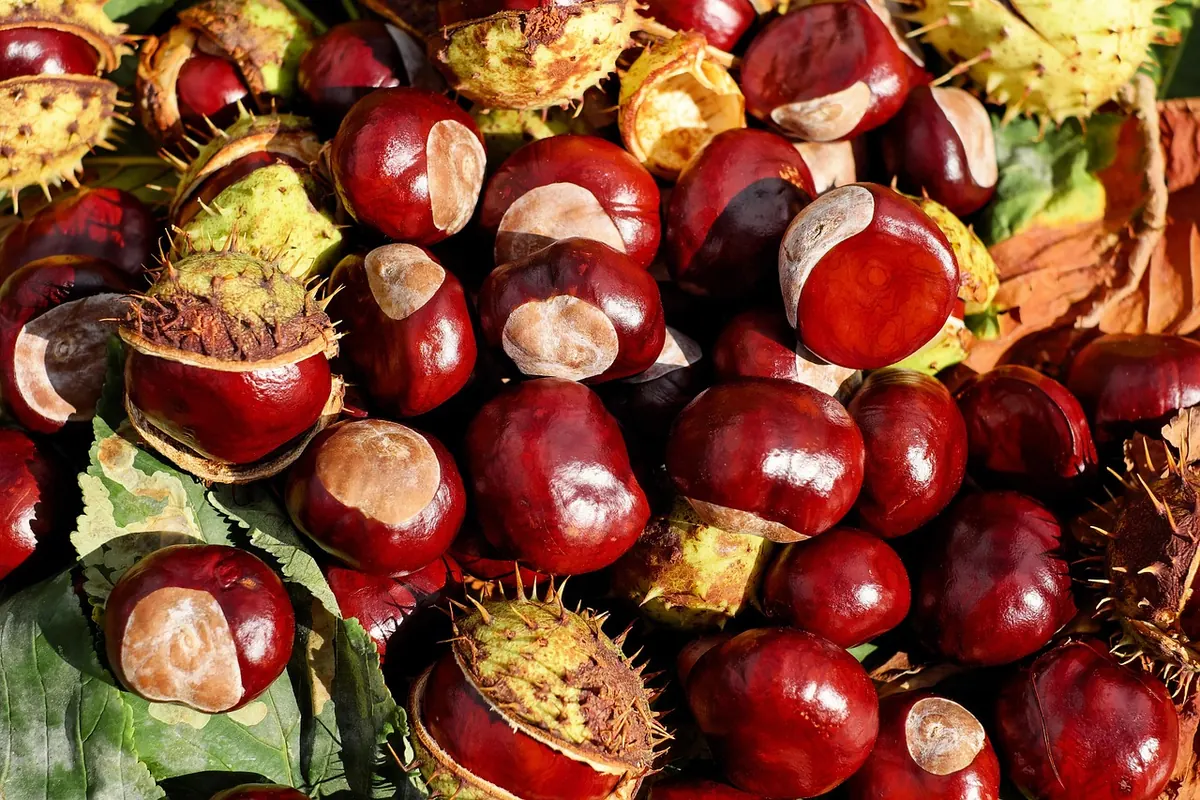
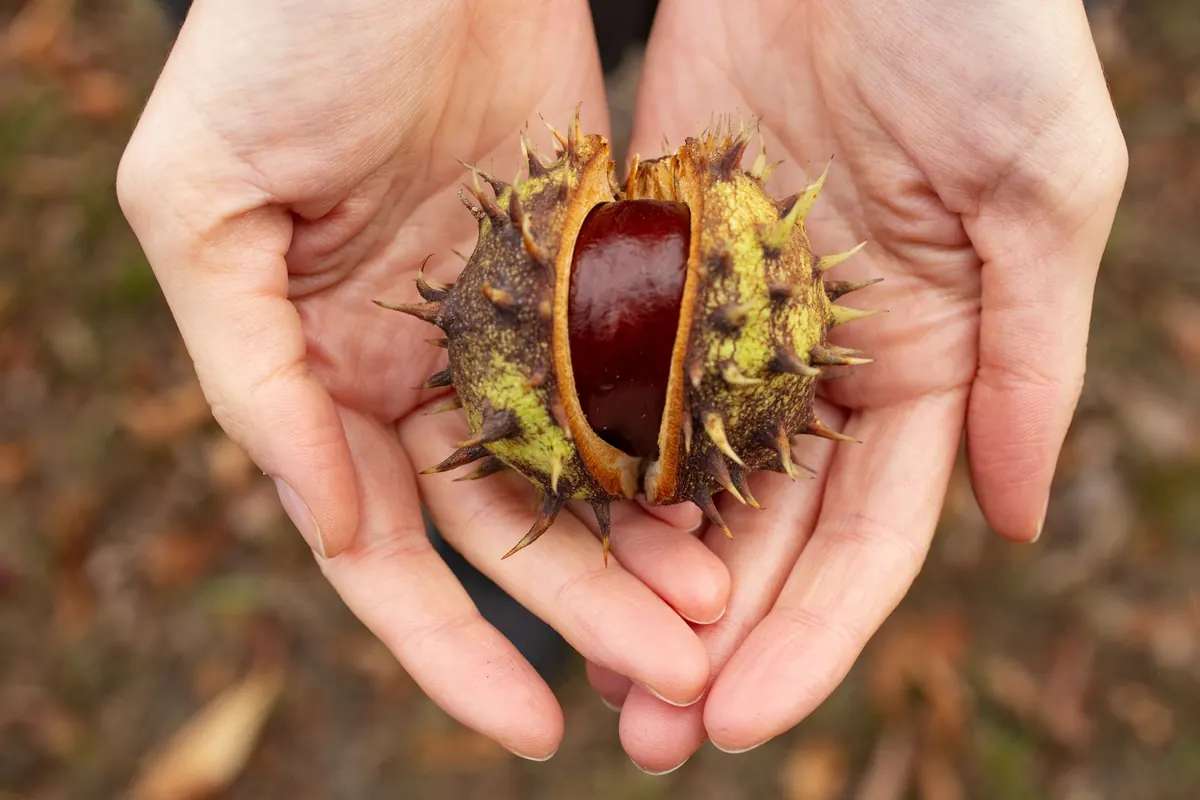
On the ground, the husk settles it. A horse chestnut husk is thick, green and fleshy, studded with a handful of short, blunt spikes, and it usually holds a single seed. A conker is round, 2–4 cm across, and so glossy it looks varnished. Its most useful feature is the pale scar — the hilum — a large oval patch where it was attached inside the husk. Conkers feel heavy and solid in the hand.
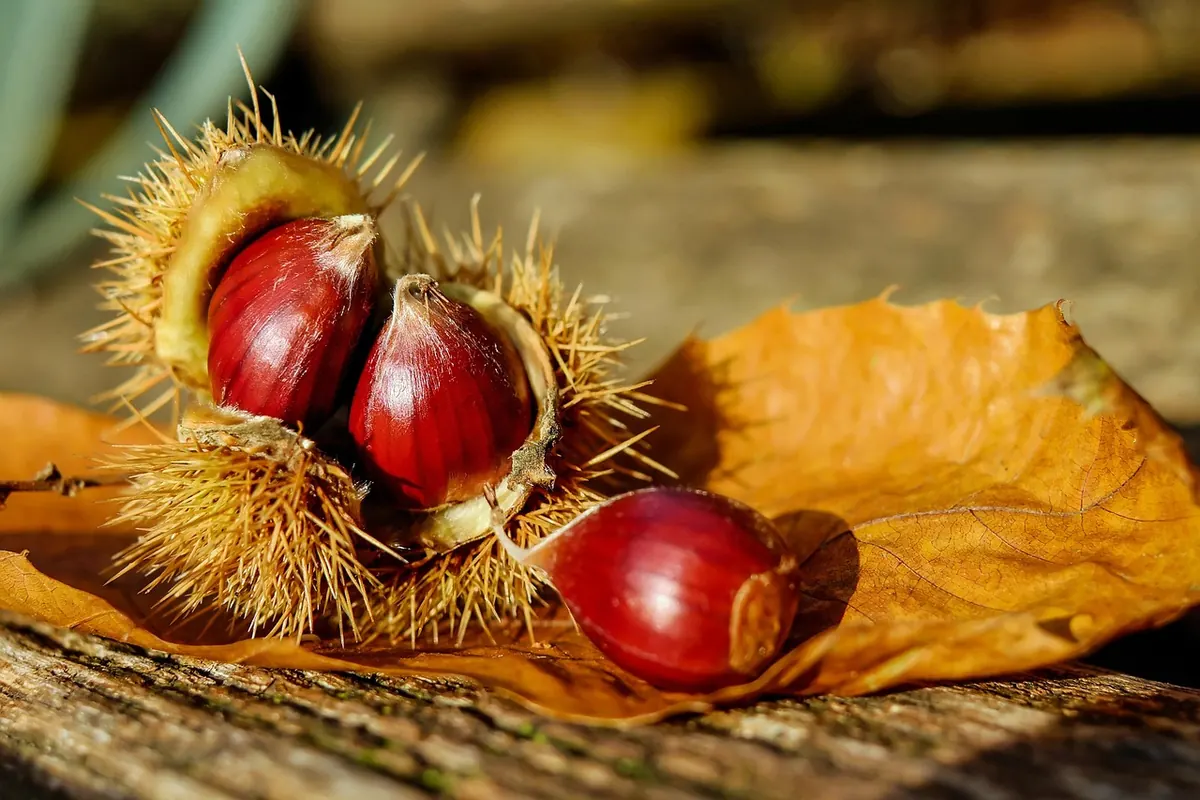
Sweet chestnuts are smaller and never perfectly round. Because two or three grow crammed into one husk, each nut is flat on one side and rounded on the other, with a pointed tip carrying a small tuft of fine hairs. The base has a paler, slightly velvety patch. A ripe sweet chestnut husk is dense with long, fine spines that prick your fingers, and it turns brown before splitting open.
Quick comparison
- Conker: one per husk, round, deep mahogany, big pale scar, few thick husk spikes.
- Sweet chestnut: two or three per husk, flat-sided, pointed tip with a tuft, pale base, many fine husk spines.
Bark, Buds and Flowers
In winter, when there's nothing else to go on, the buds settle it. Horse chestnut buds are fat, dark reddish-brown, glossy with resin, and sticky enough to leave a mark on your fingers. Just below each bud, the leaf scar is a horseshoe shape with a row of small dots inside it, like nail heads. Once you've seen that, you never confuse it again.
Sweet chestnut buds are smaller, pointed and reddish-brown, sitting on short stalks. The bark of a mature sweet chestnut is deeply furrowed, often with a spiral twist to the ridges, and the tree coppices enthusiastically — many old sweet chestnut woods are managed as coppice. Horse chestnut bark stays greyer and smoother for longer, breaking into scaly plates only on old trees.
Flowers are the easiest summer clue. Horse chestnut produces upright, cone-shaped clusters of white flowers with yellow or pink blotches in May, standing along the branch like candles. Sweet chestnut flowers are long, slender, creamy-yellow catkins appearing in June and July, with a faintly sweet smell. Where you see catkins, spiny husks will follow.
Names That Mislead
"Chestnut" is one of the most overworked words in the plant world. Water chestnut is an aquatic sedge with no relation to trees. In North America, the trees that look like horse chestnuts are buckeyes — Ohio buckeye, California buckeye — and they belong to the same genus, Aesculus, so they aren't for eating either. Sweet chestnuts belong to the genus Castanea, along with the American and Chinese chestnuts. If you find a genuinely edible chestnut in the United States, it's a Castanea.
If You Find Sweet Chestnuts
Chestnuts are unusual among nuts because they're mostly starch and water rather than oil. They also shouldn't be eaten raw: raw sweet chestnuts are hard, astringent and tough on the digestion. Score the flat side of each nut with a sharp knife so steam can escape, then roast in a hot oven or boil until the skins split and the flesh is soft and mealy. Peel them while they're still warm; the inner skin comes away far more easily.
Fresh chestnuts don't keep. They dry out, and in a warm kitchen they go mouldy within days. A cool, airy spot and a paper bag will hold them for a couple of weeks.
The Two-Minute Check
Standing under a tree in October and wanting a decision? Work through this in order:
- Leaves. Hand-shaped with five to seven leaflets? Horse chestnut. Long and saw-toothed with parallel veins? Sweet chestnut.
- Husk. A few thick, blunt spikes with one nut inside? Horse chestnut. Dense fine spines with two or three nuts? Sweet chestnut.
- Nut. Perfectly round, glossy, with a large pale scar? Conker. Flat on one side, pointed tip with a tuft, pale base? Sweet chestnut.
- Tree. Sticky fat buds and candle flowers? Horse chestnut. Small pointed buds, fissured bark and catkins? Sweet chestnut.
If any of those four checks disagree with the others, walk away. Any chestnut you're not completely certain about is a conker as far as your kitchen is concerned, and there is never a shortage of those. If someone has eaten part of a horse chestnut or buckeye by mistake, contact a poison control service or a medical professional for advice rather than waiting to see what happens.
Photo: Couleur / Pixabay